
Nigeria 2027 Election Forecast: What Six Scenarios Say About January 16


Bottom Line Up Front: President Bola Tinubu cannot win a high-turnout election in January. An OSRS model built on every presidential result since 1999 shows the Obi and Kwankwaso ticket ahead in four of six scenarios, a runoff in a fifth, and a Tinubu victory only if the Muslim North consolidates behind him after Atiku Abubakar's removal from the ballot. The decisive variables are not crowds or endorsements. They are turnout, the redistribution of Atiku's northern vote, and whether the Christian Middle Belt punishes the Muslim-Muslim ticket a second time.
Why this election is different
Nigeria holds its presidential election on Saturday, January 16, 2027, the earliest date since the return to civilian rule. Eighteen candidates are on the ballot. Three matter: President Tinubu of the ruling All Progressives Congress (APC), Peter Obi of the Nigeria Democratic Congress (NDC) with former Kano governor Rabiu Kwankwaso as running mate, and Oyo Governor Seyi Makinde of the Allied Peoples Movement (APM). A fourth, former Vice President Atiku Abubakar of the African Democratic Congress (ADC), saw his nomination voided by a Federal High Court on November 5. He is appealing. The party is likely to remain on the ballot; whether he does is now a question for the Court of Appeal.
For readers in Washington, London and Brussels, the stakes are concrete. Nigeria is Africa's largest democracy, a frontline state against jihadist insurgency, and a country where the United States has just designated religious-freedom violations a matter of particular concern. How Nigerians vote in January, and whether the result is accepted, will shape security cooperation across the Sahel for the rest of the decade.
What 24 years of voting data tell us
Since 1999, Nigeria has behaved as two voting worlds. The Muslim North has voted as a bloc for a northern Muslim candidate in every contested election since 2003. The Christian South and Middle Belt have voted against that candidate. Only three states, Sokoto, Yobe and Zamfara, have never been won by the former ruling PDP. The one incumbent defeat, in 2015, required a formal merger of four opposition parties behind a single northern Muslim and a peace accord backed by visible American attention. Neither condition exists today.

The winner's share fell from 63 percent in 1999 to 37 percent in 2023 while turnout fell from 69 percent to 27 percent.
Two trends define the modern period. The winner's share has fallen from 63 percent in 1999 to 37 percent in 2023. Turnout has collapsed from 69 percent in 2003 to 27 percent in 2023. Tinubu won with 8.8 million votes in a country of 93 million registered voters. He is the weakest incumbent in the Fourth Republic by every available measure, and he won because the opposition split three ways.

Tinubu's 2023 margin came from the North West, not the South West.
The 2023 map contains the key to 2027. Tinubu's plurality was built in the North West, where he outpolled Atiku 2.65 million to 2.20 million, not in his Yoruba South West, where Obi took Lagos, and Atiku took Osun. Obi swept the five South East states, the Christian Middle Belt and the Federal Capital Territory. Kwankwaso took Kano and almost nothing else.
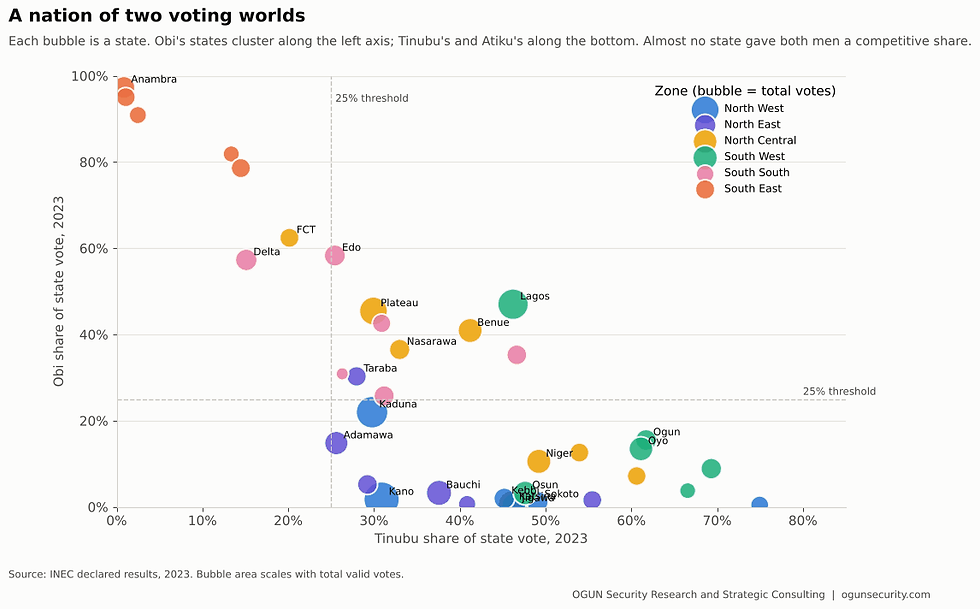
Almost no state gave both Tinubu and Obi a competitive share in 2023.
The model: six scenarios for January
OSRS mapped the 2023 state results onto the 2027 tickets and applied explicit, documented adjustments: a 12 percent shift from APC to NDC in the Christian belt, where more than 1,000 northern clerics and the Christian Association of Nigeria have both turned on the government over insecurity; a 20 percent erosion of the APC vote in the Muslim North, where clerics are now telling worshippers to take the money and vote elsewhere; and a Makinde draw of roughly one fifth of Tinubu's South West vote plus the old PDP structure there. Atiku's vote, where he is removed, is redistributed by region: in the Muslim North, 40 percent stay home and 35 percent return to Tinubu; elsewhere, 40 percent move to Obi. New voters are allocated by zone using INEC registration data and SBM Intelligence's June 2026 turnout-intention survey.

Obi leads in four of six scenarios; Tinubu leads only in a 2023 replay or with northern Muslim consolidation.
Three findings stand out.
A four-way race produces a runoff. With Atiku on the ballot, Obi leads with 34 percent but reaches 25 percent in only 19 states. Tinubu reaches it in 26 but trails on votes. No one meets both tests. Nigeria has never held a presidential runoff, and the Electoral Act 2026 gives INEC 21 days to organize one.
Removing Atiku helps Obi more than Tinubu, unless the North consolidates. In scenario C, the baseline split of Atiku's vote at 2023 turnout, Obi edges Tinubu 45 to 44 percent. That is a coin flip. In scenario F, where the Muslim North repeats its 2011 and 2015 behavior and gives 60 percent of Atiku's vote to the only Muslim-led ticket, Tinubu wins 47 to 43. Everything turns on that one redistribution.
Turnout decides it. Every two points of additional national turnout move roughly one point from Tinubu to Obi, because the new voters are young, southern and anti-incumbent. At 33 percent turnout Obi reaches 49 percent and clears the 25 percent threshold in 32 states. At 40 percent he passes a majority.

Every two points of additional turnout move roughly one point from Tinubu to Obi.
Tinubu's re-election no longer depends on persuading Nigerians. It depends on how many of them stay home.
Culture, religion and the Middle Belt
The Muslim-Muslim ticket worked in 2023 because the opposition fractured. It did not win Christian votes; it survived their division. Since then the grievance has hardened. The Yelwata killings in Benue, continuing attacks across Plateau and Southern Kaduna, and the sense among Middle Belt Christians that a Muslim president and a Muslim vice president have not protected them have converted a prediction into three years of evidence. Every opposition ticket in 2027 is religiously balanced. Only the APC asks Christians to accept exclusion from both top offices a second time.

The Christian Middle Belt is where the Muslim-Muslim ticket pays its bill.
The model shows the bill coming due in Benue, Plateau, Taraba and Nasarawa, where Obi moves from the low 40s to around 60 percent once Atiku's Christian-belt vote and new voters are counted. Kaduna is the most sensitive state in the entire model: its 554,000 PDP votes in 2023 were largely northern Muslim, and how they split will decide whether the state stays with Tinubu.
Nevertheless, the religious logic runs both ways. If Christians consolidate against the APC, northern Muslims may consolidate for it once Atiku is gone. That is precisely what scenario F describes, and it is the single most plausible path to a Tinubu victory.
The wave, the wise voter and the diaspora
Three external forces press on January without casting a single ballot.
The American midterms on November 3 handed Democrats both houses of Congress in what every network called a repudiation of the sitting president. The result does not tell Nigerians how to vote. It confirms that 2026 is a global anti-incumbent year, hands the opposition a ready-made narrative, and installs in Washington a Congress far more receptive to diaspora lobbying on electoral integrity than the one that accepted the 2023 result within days. It arrives too late to shape the election itself.
Nigerian voters have also learned preference falsification: collect the money, attend the rally, vote the other way. It happened visibly in Lagos, Plateau and Nasarawa in 2023, and a northern cleric has now said it aloud. Crowd size and endorsements are therefore poor predictors, and polls that show Tinubu rated below "poor" in every zone except the North West are probably a floor, not a ceiling.
The electorate has learned to take the incumbent's money and withhold its vote. That makes every rally a lie detector that fires only on election day.
The economy cuts the same way. Headline inflation has fallen from 34.8 percent in December 2024 to under 16 percent, and the APC will campaign on that number. However, the United Nations warned that 35 million Nigerians faced acute hunger this year, federal workers rejected the new minimum wage, and nearly 80 percent of respondents in every credible survey say the country is on the wrong track. Economic voting runs on the second set of numbers.
An Analyst's View
The defensible conclusion is narrower and stronger than "Tinubu will lose." Tinubu cannot win a high-turnout election. His re-election depends on three things happening together: the Muslim North consolidating behind him after Atiku's exit, turnout staying near the 2023 floor, and the machinery of state delivering in the Niger Delta and the South West. Any one of those failing produces either an Obi plurality or a first-ever runoff. In 2015 the loser faced a credible international cost for refusing to concede. In 2027 the incumbent faces none. That asymmetry, more than any poll, is what decision-makers in Washington and Abuja should be planning for.
What OSRS can do
OGUN Security Research and Strategic Consulting delivers scenario modeling, open-source intelligence and election-risk assessments for governments, corporations, diplomatic missions and investors operating in Nigeria and across Africa. The full model behind this analysis, including state-level outputs under every scenario, is available to clients. Contact us at contact@ogunsecurity.com.
Share this analysis with colleagues who follow African security and governance, and subscribe to our email list for OSRS intelligence briefs. Enjoyed this article? Stay informed by following us on Google News, Twitter, and LinkedIn for more exclusive cybersecurity insights and expert analyses.
Intelligence. Protection. Strategy. www.ogunsecurity.com


Comments