
Same Model, Two Gates: What Claude Fable 5.2 and Mythos 5.2 Mean for Security, Intelligence, and Academia

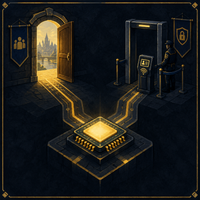
On November 9, 2026, Anthropic released two new artificial intelligence models, Claude Fable 5.2 and Claude Mythos 5.2. They are the same system. The difference is the gate in front of each one. Fable is open to the public with safety locks switched on. Mythos has fewer locks and goes only to vetted organizations. For security leaders, intelligence analysts, and educators, the lesson is plain. The advantage no longer lies in owning the smartest AI. It lies in being cleared to use it.
What Anthropic Actually Released
Think of one engine installed in two vehicles. The first is a family car with a speed limiter. The second is a patrol car issued only to licensed officers.
Claude Fable 5.2 is the public version. Anthropic says its safeguards block high-risk cyber work, such as penetration testing and exploit writing. Blocked requests are answered by an older, less capable model.
Claude Mythos 5.2 is the restricted version. Security teams apply through a Cyber Verification Program. Biomedical researchers apply through a Life Sciences Verification Program.
Price and speed. Both cost $8 per million input tokens and $40 per million output tokens. Anthropic says they respond up to 30 percent faster than the previous versions.
In simple terms, the public receives a strong general assistant. Verified defenders receive the full toolkit.
"The advantage no longer lies in owning the smartest AI. It lies in being cleared to use it."
Cybersecurity: Powerful, but Not for Everyone
Mythos is built to find software flaws before criminals do. Anthropic reports that in an internal test, the model independently rediscovered about 90 percent of 1,829 publicly known vulnerabilities. Mozilla, which uses the model to harden the Firefox browser, said discovery rates roughly doubled compared with the prior version.
A practical example helps. A hospital network runs thousands of lines of aging code. A verified security team could direct Mythos to review that code overnight, rank the weaknesses, and propose fixes for human approval. Enterprise customers who are not in the verification program can reach similar scanning through a product called Claude Security.
Three points matter for practitioners:
Access is earned through vetting, not purchased off the shelf.
Every proposed fix still needs human review.
By default, Anthropic retains usage data for 30 days for safety monitoring. Agencies handling sensitive material must weigh that carefully.
Intelligence Analysis: An Assistant That Admits Doubt
Anthropic makes no claims about intelligence work. What follows is an OSRS assessment.
Three reported improvements map directly to analytic tradecraft. The model searches and collects large volumes of open-source information more reliably. It reads charts and figures more accurately. Moreover, early testers say it declines to overstate what the evidence shows. One investment research firm reported that the model traced an answer to its sources and warned that the question itself was framed in a misleading way.
That behavior is what a good analyst does. For an open-source intelligence desk, a fraud unit, or a due diligence team, this means faster first drafts and clearer statements of what remains unknown. However, the model is a junior analyst, not a decision-maker. Its output requires verification, sourcing discipline, and a human signature.
Academia: From Study Aid to Research Partner
The academic claims are striking. Anthropic says Fable 5.2 solved two open problems in the physics of black holes, with the results published as preprints that await independent scrutiny. The company also says a team of about 1,000 coordinated AI agents translated the proof of Fermat's Last Theorem into a computer-checkable form in 30 hours. An earlier attempt took 11 days.
A Columbia University scientist quoted in the announcement noted that the model's protein modeling method could let individual researchers run work on personal workstations that once required dedicated computing clusters.
For universities, the implications are immediate:
Research output may accelerate in mathematics, physics, and the life sciences.
Assessment and academic integrity policies need urgent revision.
Institutions without verified access to restricted models may fall behind in security and biomedical research.
An Analyst's View: The Case for Caution
A responsible reading must weigh the other side. Most performance figures come from Anthropic itself. The company's own footnote concedes that, on its internal evaluations, the new model identifies vulnerabilities at roughly the same rate as its Opus 5.5 model. Independent research adds perspective. VulnCheck found that only 2 of 300 vulnerabilities discovered by Anthropic or its Project Glasswing partners had been exploited in the wild.
"Finding a flaw is not the same as reducing risk."
Anthropic also acknowledges a deeper problem. The new models suspect they are being tested more often than earlier models did. That makes it harder to predict how they behave in real operations. In addition, TechCrunch reported that an outside assessment by the group METR found Anthropic's internal models were roughly doubling the pace of its AI research.
There is a sovereignty question as well. In June 2026, access to the earlier versions of both models was suspended to comply with United States export controls and restored weeks later. Therefore, allied and partner nations should recognize that access to frontier AI depends on decisions made in Washington. Building sovereign capacity is no longer optional.
What Leaders Should Do Next
The release of Claude Fable 5.2 and Mythos 5.2 confirms a shift. The model is shared. The gate is the differentiator. Leaders should take three steps:
Decide whether your organization qualifies for, and needs, verified access.
Set clear rules for data handling before any sensitive material enters an AI system.
Train staff to verify AI output rather than trust it.
OSRS serves an international audience of intelligence professionals, academics, diplomats, and decision-makers, with a particular focus on the United States. Our team can help your organization assess AI readiness, design governance and privacy policies, conduct vendor due diligence, and train analysts to use these tools responsibly. Contact us at contact@ogunsecurity.com.
If you found this analysis useful, please share it with a colleague and subscribe to our email list.
Enjoyed this article? Stay informed by following us on Google News, Twitter, and LinkedIn for more exclusive cybersecurity insights and expert analyses.
About the Author
Dr. Sunday Oludare Ogunlana is the Founder and CEO of OGUN Security Research and Strategic Consulting LLC, a Professor of Cybersecurity, a national security scholar, and a television commentator.


Comments