
The Great Repositioning: What Moving US Drones from Africa to South America Really Signals

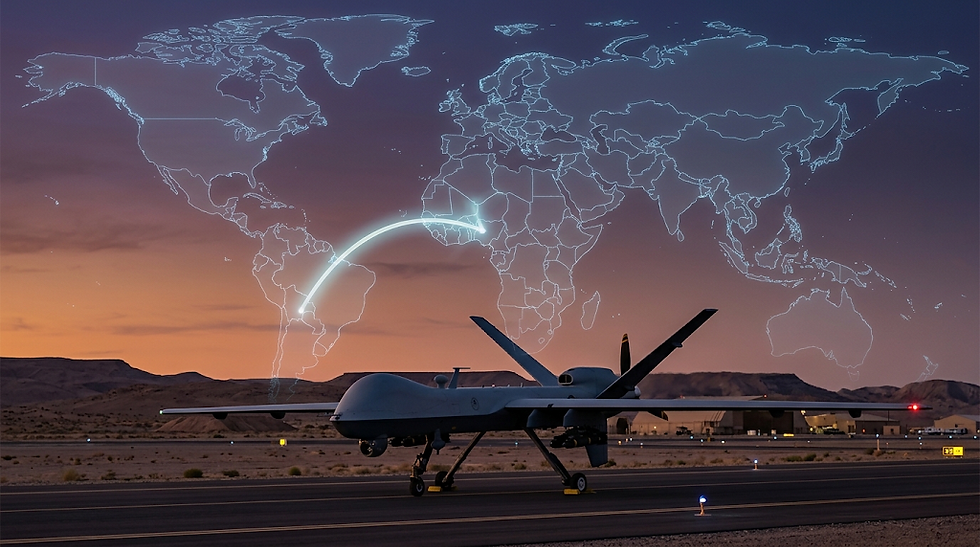
The Pentagon is preparing to move most of its MQ-9 Reaper drones from Africa to South America, according to a CNN exclusive published today. This is not a logistics story. It is doctrine made visible. Washington is trading global counterterrorism coverage for hemisphere defense at the very moment its Middle East bases lie battered from the war with Iran and its African partners are shopping for new security patrons. For military, intelligence, and law enforcement professionals, and for the business leaders and policymakers who depend on them, this single equipment transfer tells you where American power is going and where it is not.
What Is Moving, and Why
The MQ-9 Reaper is the workhorse of modern American surveillance and strike operations. It is a remotely piloted aircraft that can watch a target for hours, collect intelligence, and fire precision weapons. Six sources told CNN that most of the Reapers assigned to US Africa Command are expected to transfer to US Southern Command, the headquarters responsible for South America.
The move follows a wave of hardware already sent to the region. Last year, the military deployed Reapers, F-35 fighter jets, and at least one AC-130 gunship to the Caribbean for its campaign against alleged drug-smuggling vessels. Now the administration is openly planning land operations with partner nations. Ecuador began joint military operations with the United States against designated terrorist organizations earlier this year, and officials say more partnerships are coming.
The strategic logic was written down months ago. Defense Secretary Pete Hegseth's National Defense Strategy, released in January, named defending the American homeland and the Western Hemisphere as the Pentagon's first priority. Africa now ranks below the Pacific, the Middle East, and Europe. The drones are simply following the doctrine.
"This is not a logistics story. It is doctrine made visible."
The Middle East Question: Rebuild or Retreat?
The transfer cannot be separated from the war with Iran. Some of the Reapers leaving Africa may go to the Middle East instead, because the United States lost aircraft, including MQ-9s, during the conflict. That detail points to a much larger problem.
During the 2026 war, Iranian missiles and drones struck American installations across the Gulf, including Al Udeid Air Base in Qatar, Ali Al Salem in Kuwait, Al Dhafra in the United Arab Emirates, and the Fifth Fleet headquarters in Bahrain. Open-source trackers count more than a dozen damaged installations, and some analysts put the number above twenty. US Central Command reported 13 service members killed and roughly 380 wounded. The strikes are paused under the ceasefire signed in June, which includes provisions for American forces to pull back from Iran's vicinity.
Washington now faces a genuine posture decision. Reporting indicates the Pentagon is weighing a smaller footprint in the Persian Gulf rather than rebuilding strike-battered bases. Concentrated mega-bases within range of Iranian missiles proved to be liabilities, not sanctuaries.
Did the American and Israeli campaign leave Iran stronger or weaker? Honest analysts disagree. Iran absorbed the strikes, demonstrated sharply improved targeting of American assets, and imposed real costs on a superpower. However, Tehran also suffered heavy damage to its nuclear and missile infrastructure and lost senior commanders. What is beyond dispute is this: Iran changed the economics of forward basing, and the drone transfer to South America shows the Pentagon has absorbed that lesson.
The Africa Vacuum: Russia's Opening and Its Limits
Nature abhors a vacuum. Strategy abhors it more. The American drawdown from Africa comes despite warnings from US military leaders that ISIS and al-Shabaab continue to flourish as the American presence shrinks. Sources told CNN that counterterrorism strikes will continue, but even insiders concede that losing the Reapers will make those operations harder.
Russia has been preparing for this moment. Its Africa Corps, the defense ministry's successor to the Wagner Group, fields roughly 3,500 fighters in Mali and maintains deployments in the Central African Republic, Libya, Burkina Faso, Niger, and beyond. When Washington withdrew more than 1,000 troops from Niger, previously its second-largest presence on the continent, Russian personnel moved onto the same airbase. Moscow has since signed an expanded military pact with the Alliance of Sahel States.
"African governments now shop for security partners the way they shop for trade deals."
Nevertheless, Russia's opening has limits. In April 2026, Tuareg rebels allied with al-Qaeda's Sahel branch forced Russian troops out of Kidal, a city Wagner had helped the Malian junta capture. Russia fills the political vacuum faster than it fills the security vacuum.
What about China? A common assumption holds that Beijing does not build military presence outside its region. That is no longer accurate. China has operated a naval base in Djibouti since 2017, held a joint naval exercise with Russia, Iran, and South Africa off the South African coast this year, and pledged to train thousands of African military and police personnel. China's model is basing-lite: training, exercises, and economic leverage rather than combat deployments. It is influence on the installment plan.
What Practitioners Should Watch
Four indicators deserve close attention in the months ahead:
Intelligence gaps in the Sahel and the Horn. Fewer Reapers means less persistent surveillance. Expect slower warning of terrorist plots that can reach Europe and the American homeland.
The Gulf posture decision. Whether Washington rebuilds, hardens, or disperses its Middle East bases will define deterrence against Iran for a decade.
Escalation risk in South America. Drone strikes on foreign soil raise hard legal and sovereignty questions. Counternarcotics can become counterinsurgency quickly.
Partner realignment. Watch which African states sign new agreements with Moscow or Beijing, and which South American states resist deeper American involvement.
The Bottom Line
The drone transfer is a signal flare. American power is concentrating closer to home, adversaries are testing the seams, and states across two continents are recalculating their security partnerships. The organizations that thrive in this environment will be those that see the repositioning early and plan for the gaps it creates.
OSRS can help. Our team provides intelligence-driven security research, geopolitical risk assessments, and strategic advisory services for government, law enforcement, and private-sector leaders navigating shifting global postures. Contact us to schedule a briefing or a strategic risk assessment for your organization.
Enjoyed this article? Share it with a colleague who needs to see it. Stay informed by subscribing to our email list and following us on Google News, Twitter, and LinkedIn for more exclusive security insights and expert analyses.
About the Author
Dr. Sunday Oludare Ogunlana is the Founder and CEO of OGUN Security Research and Strategic Consulting LLC, a Professor of Cybersecurity, a national security scholar, and a television commentator. He advises government, academic, and private-sector organizations on security strategy and serves as a leading voice on intelligence, counterterrorism, and emerging technology threats.
Intelligence. Protection. Strategy. www.ogunsecurity.com


Comments