
Drones, Helicopters, or Surveillance Aircraft? Building Defense in Depth for Oyo State


Since Oyo State took delivery of two Diamond DA42 MNG surveillance aircraft, social media has hosted a spirited debate. Some insist drones would have been cheaper. Others favor helicopters. Still others defend the fixed-wing choice. The debate is healthy, but it needs facts. Bottom line up front: the question is not which platform wins. Serious security architecture layers all three, and Governor Seyi Makinde has wisely acquired the anchor layer first.
What Drones Actually Offer, and What They Cannot
Drones dominate modern security conversations for good reason. In the Global North, large Medium Altitude Long Endurance (MALE) systems like the American Reaper patrol borders for entire days. In the Global South, Nigeria's own federal forces fly Turkish and Chinese combat drones against insurgents, while the Nigeria Police has deployed fixed-wing UAVs and tethered surveillance drones, and the Army has fielded mini-UAVs for localized reconnaissance and recently graduated specialized drone operators in Sokoto.
However, a subnational government faces hard realities:
Access: MALE-class drones are military systems controlled by export restrictions and federal airspace authority. No Nigerian state can simply buy one.
Endurance and payload: The drones states can legally acquire fly for minutes to a few hours and carry light cameras, not the heavy stabilized sensors that identify targets from altitude.
Data burden: Research on Nigeria's drone operations consistently finds the same gap: plenty of footage, too few trained analysts to exploit it.
The threat has drones too: ISWAP and bandit groups now fly commercial quadcopters. Any state drone program must plan for counter-drone measures from day one.
Drones are essential. They are also insufficient alone.
The Aircraft Oyo Bought Is in Good Company
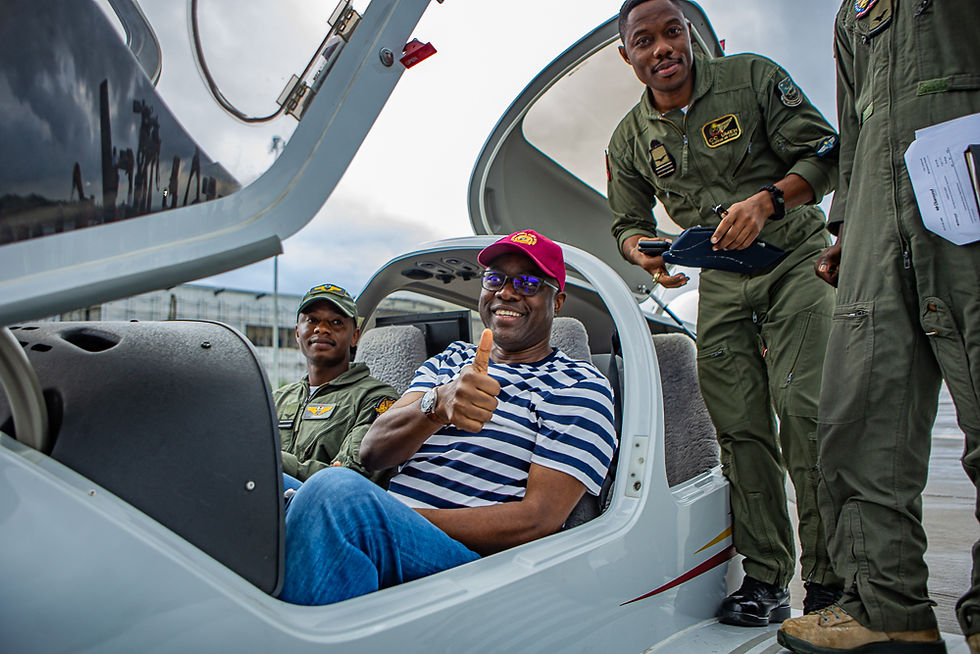
Critics who call the DA42 a private plane should study who flies its surveillance variants. Canada's Royal Canadian Mounted Police launched the type for patrolling the American border. The UK's Royal Air Force flew DA42 surveillance platforms over Iraq and during security operations for the London 2012 Olympics. Border guard services in Europe and security agencies across several continents operate it for exactly the missions Oyo intends: long, quiet patrols over green borders and difficult terrain.
"Canada patrols its border with this aircraft family. The RAF flew it over Iraq. Oyo State is not experimenting. It joined a proven club."
The platform's strengths fit Oyo precisely: eight to ten hours of endurance, low noise for discreet observation, diesel engines running on affordable Jet-A1 fuel, and the capacity to carry electro-optical, infrared, and even communications intelligence payloads. Critically, its real-time data links let it feed a fusion center, where analysts merge aerial video with ground intelligence and dispatch responders. Interoperability is the entire point. An aircraft that streams into a fusion center multiplies every other asset the state owns.
Helicopters: Powerful, Expensive, and Easily Misused
Helicopters bring what neither drones nor fixed-wing aircraft can: vertical lift. They insert tactical teams, extract victims, evacuate casualties, and pursue targets at low level. No complete security architecture excludes them forever. Nevertheless, they cost several times more per flight hour, demand intensive maintenance, and tempt misuse. Osun State's helicopter, purchased without a security mission design, famously drifted into passenger charter work. The lesson is not that helicopters fail. It is that platforms without architecture fail.
Defense in Depth for Oyo State
Considering Oyo's profile, the largest state in the Southwest with vast forest corridors, the Old Oyo axis, and a porous border with the Republic of Benin, the layered sequence should run:
Fixed-wing ISR aircraft for wide-area coverage. Acquired.
A fusion center with trained analysts, AI-assisted video exploitation, and cyber assets. The urgent next step.
Tactical drones for persistent watch over flashpoints and rapid tasking by Amotekun.
Ground response capacity: vehicles, forward bases, communications.
A helicopter, later, for insertion and rescue, governed by strict mission rules.
The State Police Opportunity
As Nigeria moves toward adopting state police, Governor Makinde's vision deserves commendation for a deeper reason. The agency that will stand at the forefront of protecting lives and property, the agency responsible for public safety in Oyo, is being equipped before it is even born. When state police arrive, Oyo will hand its officers a functioning aerial intelligence capability while other states hand theirs a blank sheet. That is what strategic leadership looks like. Every governor holding a security vote should study this sequence and begin their own.
OSRS advises governments on layered security architecture, fusion center design, drone program development, and state policing readiness. Visit www.ogunsecurity.com to begin the conversation.
Found this valuable? Share it with a colleague and subscribe to our email list for weekly intelligence briefs.
Enjoyed this article? Stay informed by following us on Google News, Twitter, and LinkedIn for more exclusive cybersecurity insights and expert analyses.
About the Author
Dr. Oludare Ogunlana is the Founder and CEO of OGUN Security Research and Strategic Consulting LLC (OSRS), a Professor of Cybersecurity, and a national security scholar who advises global intelligence and policy bodies on African security, intelligence architecture, and AI governance.

Comments