
Nigeria's Innovation Diplomacy Goes Global: NBTI Signs Commonwealth MoU for NextGen Innovation Challenge 2027


Nigeria's National Board for Technology Incubation (NBTI) has signed a Memorandum of Understanding with the Commonwealth Businesswomen's Network (CBWN) and its international partner UKALD Ltd. to expand its flagship NextGen Innovation Challenge across all 56 Commonwealth Member States. The signing, held on 20 July 2026 at Nigeria House in London, marks a significant moment in Nigerian innovation diplomacy. It positions a Nigerian federal agency as the anchor of a pan-Commonwealth innovation program for the first time.
OSRS assesses this development as a strategic win for Nigerian soft power, Global South technology sovereignty, and youth enterprise development.
What Happened
On Monday, 20 July 2026, NBTI, UKALD Ltd., and CBWN signed an MoU to jointly organize and deliver the Commonwealth-NBTI NextGen Innovation Challenge 2027. The agreement transforms NBTI's domestic flagship program into a pan-Commonwealth platform reaching entrepreneurs and innovators across all 56 Member States.
The ceremony took place at Nigeria House, the Nigerian High Commission in London, hosted by Ambassador Abu-Obe Eche. The Director-General and CEO of NBTI, Dr. Kazeem Kolawole Raji, led the Nigerian delegation alongside UKALD partners and the CBWN team.
Moreover, the parties discussed plans for a formal launch of the Challenge at the Commonwealth Heads of Government Meeting (CHOGM) in Antigua and Barbuda this November, ahead of full program rollout in 2027.
"This is the first time a Nigerian technology incubation agency has anchored a Commonwealth-wide innovation platform. The symbolism matters, and so does the substance."
Why This Matters: The OSRS Assessment
1. Innovation diplomacy is national power. States that export innovation frameworks shape the rules of the innovation economy. Nigeria has long been a consumer of externally designed accelerator and incubation models. This MoU reverses that flow. A Nigerian institution now sets the template that 55 other Commonwealth states will engage with. That is soft power in its most practical form.
2. The CBWN partnership signals inclusive enterprise strategy. Partnering with the Commonwealth Businesswomen's Network embeds women's enterprise development into the Challenge architecture from the outset. Across Africa, women-led ventures remain systematically underfunded despite strong performance data. A Commonwealth platform with CBWN at the table creates structural access, not token inclusion.
3. CHOGM is the right launch platform. Launching at the Commonwealth Heads of Government Meeting in Antigua and Barbuda places the Challenge before heads of state and government at the highest political level. Programs launched at CHOGM acquire institutional durability that ministry-level initiatives rarely achieve. Nevertheless, the real test will be execution: funding commitments, national focal points, and transparent selection criteria must follow the ceremony.
4. Technology incubation is a security instrument. OSRS has consistently argued that youth enterprise and innovation ecosystems are frontline instruments of national security. Economies that absorb young talent into productive innovation reduce the recruitment pool for criminal and extremist networks. Scaling the NextGen model across the Commonwealth extends that logic to a community of 2.7 billion people, most of them under 30.
The Institutional Context
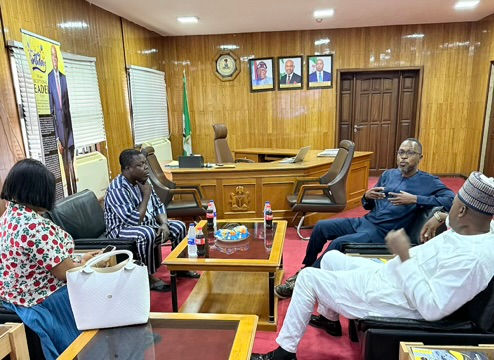
OSRS engaged directly with NBTI leadership earlier this year during a courtesy visit to Director-General Dr. Kazeem Kolawole Raji. What stood out then, and what this MoU confirms, is a deliberate institutional strategy: consolidate the domestic incubation mandate, professionalize delivery, then internationalize the flagship. The London signing is the third step in that sequence executing on schedule.
"Economies that absorb young talent into productive innovation reduce the recruitment pool for criminal and extremist networks."
What to Watch
Three indicators will determine whether this MoU becomes a durable platform or a photo opportunity:
First, the CHOGM launch in November. Watch for named funding partners and a published program framework, not just a launch event.
Second, national focal point designation. A 56-state challenge requires in-country delivery partners. The speed and quality of those designations will reveal the seriousness of the rollout.
Third, Nigerian domestic alignment. NBTI must demonstrate that international expansion strengthens, rather than distracts from, its core mandate of technology incubation across Nigeria's states.
Conclusion
The Commonwealth-NBTI NextGen Innovation Challenge 2027 represents Nigerian institutional ambition operating at the right scale. Therefore, OSRS congratulates Dr. Raji and the NBTI team on a milestone that advances Nigerian innovation diplomacy and Global South technology leadership. The work now shifts from signing tables to delivery systems. We will be watching and reporting.
Dr. Sunday Oludare Ogunlana is Founder and CEO of OSRS, a Professor of Cybersecurity, and a national security scholar who advises global intelligence and policy bodies on innovation, technology governance, and African security affairs.
Enjoyed this article? Stay informed by following us on Google News, Twitter, and LinkedIn for more exclusive cybersecurity insights and expert analyses.
Intelligence. Protection. Strategy.


Comments