
What Does a Licensed Security Guard Actually Do? Separating Myth from Reality


Most people picture a security guard standing quietly at an entrance, checking badges or waving cars through a gate. That image is not entirely wrong. But it is incomplete in ways that can leave organizations exposed to threats they never saw coming. In an era of rising workplace incidents, geopolitical instability, and increasingly sophisticated physical threats, understanding what a professionally trained, licensed security guard actually does is not just relevant; it is operationally essential.
The Uniform Is Not the Security Plan
The most expensive mistake organizations make in physical security is treating guard services as a commodity. The logic goes: put a uniformed person at the door, and the deterrence box is checked. For low-risk environments, that may appear to work. For corporate offices, healthcare facilities, government buildings, financial institutions, and critical infrastructure, it is a liability waiting to materialize.
A licensed security guard is not a prop. In Texas, for example, guards must be licensed through the Texas Department of Public Safety Private Security Bureau, a process that involves background verification, formal instruction, and ongoing compliance. OSRS holds TX DPS License #C30816901 and treats those standards as a starting point, not a finish line.
What a Trained Guard Actually Does: The Four Core Functions
Professional guard services operate across four distinct layers of security activity:
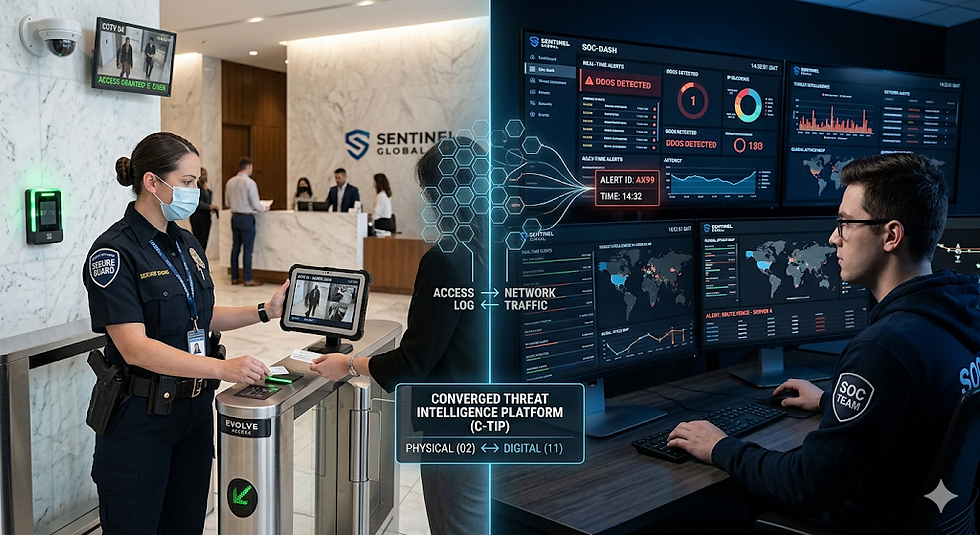
1. Access Control and Entry Management Guards verify credentials, screen visitors, maintain entry logs, and regulate movement through sensitive areas. This is not administrative work. It is the first intelligence layer between an organization and an unauthorized actor.
2. Observation, Patrol, and Threat Detection Trained guards conduct both scheduled and randomized patrols. They are trained to recognize pre-incident indicators, behavioral anomalies, and environmental vulnerabilities that cameras and sensors alone cannot interpret. Mobile patrol services extend this coverage to commercial and residential properties beyond a fixed post.
3. Emergency Response and Incident Command Support When an incident occurs, a trained guard is the first professional on scene before law enforcement arrives. They stabilize the situation, initiate emergency communication protocols, coordinate evacuation, and preserve the scene for investigation. That response window is often the difference between a contained incident and a catastrophic one.
4. Documentation and Reporting Every observation, anomaly, and incident a guard records feeds organizational intelligence. Accurate, timestamped reporting supports internal investigations, legal proceedings, insurance claims, and long-term security planning. For organizations subject to regulatory oversight, this documentation is often a compliance requirement.
Why Intelligence-Led Guard Services Are Different
Most guard companies deploy personnel. OSRS deploys personnel within a strategic security framework. Our guards operate as part of a broader intelligence and consulting architecture, meaning that every protective assignment is informed by threat assessment, sector-specific risk analysis, and client operational context. A guard assigned to a financial institution is briefed differently than one assigned to a healthcare campus or a government facility. That is not standard practice in the industry. At OSRS, it is the baseline.
This approach is particularly relevant for organizations that sit at the intersection of physical and digital risk, including technology firms, federal contractors, academic research institutions, and multinational corporations managing cross-border operations.
What This Means for Your Organization
Physical security is not a line item to minimize. It is a risk management function that, when executed professionally, protects people, preserves assets, and shields organizational reputation. The guard at your entrance is making real-time decisions that carry legal, operational, and human consequences.
Before your next procurement cycle, ask not just how much a guard service costs, but what it delivers. Ask about licensing, training standards, incident reporting protocols, and whether the provider integrates physical security into a broader risk picture.
OSRS offers customized protective guard services for corporate offices, government buildings, healthcare facilities, educational institutions, financial organizations, residential communities, and event venues across Texas and nationally. Our team is ready to assess your environment and build a security plan that reflects the actual threat landscape your organization operates in.
Contact OSRS today at www.ogunsecurity.com or call (469) 469-3877 to schedule a consultation.
The Bottom Line
A licensed security guard does far more than stand at a door. They observe, assess, respond, document, and protect. The organizations that understand this distinction invest in trained professionals and build physical security programs that actually work. Those that do not often find out the hard way.
Enjoyed this article? Share it with your network and help raise the standard of physical security awareness across your sector.
Stay informed: Follow OSRS on Google News, Twitter/X, and LinkedIn for expert security analysis, intelligence updates, and exclusive insights delivered directly to your feed.
Subscribe to the OSRS email list at www.ogunsecurity.com and never miss a critical security briefing.
Author Bio: Dr. Sunday Oludare Ogunlana is Founder and CEO of OSRS, a Texas-licensed intelligence and security firm, a Professor of Cybersecurity, and a national security scholar advising global intelligence and policy bodies.

Comments