
The Convergence of Physical and Cyber Threats: Why Your Security Guard and Your IT Team Need to Talk

By Dr. Sunday Oludare Ogunlana | OGUN Security Research and Strategic Consulting (OSRS)
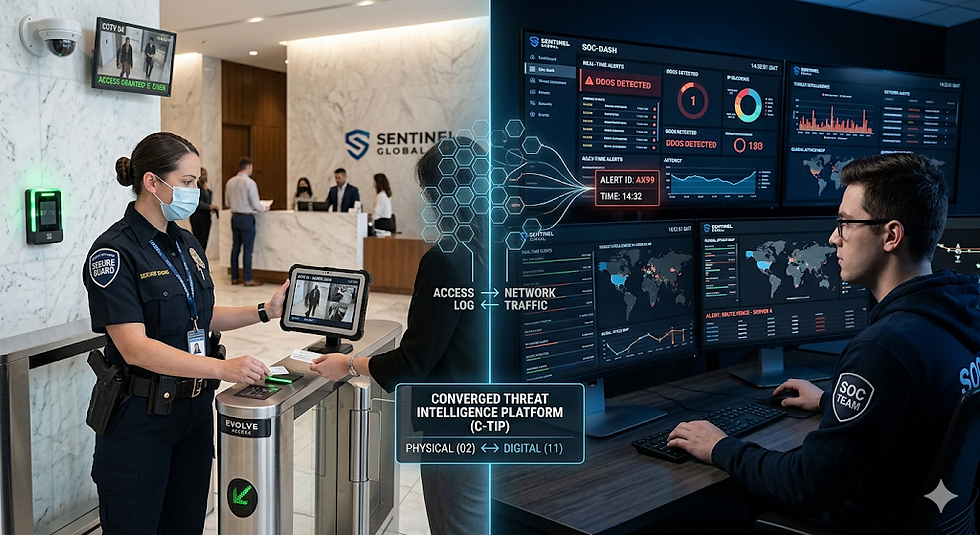
Somewhere in your organization right now, a security guard is monitoring who walks through the front door. A few floors up or across a network connection, your IT team is monitoring who accesses your systems. These two professionals are solving the same fundamental problem: keeping unauthorized actors out of your organization's spaces and systems. In most organizations, they have never spoken to each other. That silence is a security vulnerability.
The convergence of physical and cyber threats is one of the defining security challenges of our era. Adversaries, whether criminal networks, nation-state actors, or insider threats, do not respect the organizational chart. They exploit the seams between departments. And the seam between physical security and cybersecurity is, in most organizations, wide open.
Two Departments, One Threat Landscape
For decades, physical security and information security developed as separate disciplines with separate budgets, separate leadership, and separate operating assumptions. A security guard's world was access badges, perimeter patrols, and surveillance cameras. An IT security analyst's world was firewalls, endpoint detection, and network logs. The two rarely intersected.
That separation made sense in an earlier era. It makes very little sense now. Consider what the modern threat environment actually looks like:
A ransomware group researches a target organization's building layout before deploying an insider to physically access a server room.
A foreign intelligence actor tailgates an employee through an unsecured entrance to plant a hardware implant on a workstation.
A disgruntled employee uses physical access to areas they should no longer be permitted to enter because no one communicated their termination status to the security desk.
An attacker compromises a building management system through an unsecured IoT device and uses it as a pivot point into the corporate network.
Each of these scenarios involves both a physical dimension and a cyber dimension. Each one falls through the gap between two departments that are not communicating.
The Anatomy of a Converged Attack
Understanding how converged attacks work is the first step toward defending against them. Most sophisticated threat actors follow a pattern that security professionals recognize as the attack lifecycle: reconnaissance, initial access, persistence, and execution. What is less widely understood is how frequently the physical and cyber elements of that lifecycle are intertwined.
Physical reconnaissance often precedes cyber intrusion. Adversaries observe building layouts, employee routines, and access control weaknesses before ever touching a keyboard. Conversely, cyber intrusions frequently enable physical access: compromised credential databases yield badge numbers and access codes, and hacked camera systems eliminate the risk of being observed during a physical breach.
The implication for organizations is significant. A cyber incident is often also a physical security event, and vice versa. Treating them as separate categories means that the full picture of an attack is never visible to either team investigating it.
What a Converged Security Model Looks Like in Practice
Organizations that have closed the gap between physical and cyber security share several operational characteristics worth examining:
Unified Threat Intelligence Sharing Physical security personnel receive briefings on active cyber threat campaigns targeting the organization. IT teams receive alerts when physical anomalies, such as unauthorized access attempts or unfamiliar devices in restricted areas, are observed. Both teams operate from the same threat picture.
Integrated Incident Response Protocols When a security event is detected, regardless of whether it is physical or digital in origin, the response protocol activates personnel from both disciplines. A server room intrusion triggers both an IT forensics response and a physical security investigation simultaneously.
Cross-Trained Personnel and Joint Exercises Security guards receive basic cyber awareness training so they can recognize social engineering attempts, tailgating schemes, and suspicious device placement. IT staff understand physical access control systems and the vulnerabilities inherent in them. Joint tabletop exercises test the organization's ability to respond to converged attack scenarios.
Coordinated Access Management Personnel changes, terminations, and role transitions are communicated in real time to both physical security and IT. This closes one of the most commonly exploited vulnerabilities in organizational security: the gap between HR actions and access revocation.
Why OSRS Is Uniquely Positioned to Help
Most security firms offer either physical guard services or cybersecurity consulting. Very few credibly offer both from a unified intelligence-led framework. OSRS is one of them.
Our Protective Guard Services are deployed within the same strategic architecture that supports our cybersecurity consulting, regulatory compliance, threat intelligence, and digital forensics practices. That means when OSRS assesses a client's security posture, we are not looking at the front door in isolation from the network. We are looking at the full operational environment, identifying where physical and cyber risks intersect, and building integrated protective strategies that address both.
For corporate offices, government facilities, healthcare organizations, financial institutions, educational campuses, and critical infrastructure operators, this integrated approach is not a premium upgrade. It is the appropriate standard of care for the threat environment we all now operate in.
Contact OSRS today at www.ogunsecurity.com or call (469) 469-3877 to schedule a converged security assessment.
The Bottom Line
Your security guard and your IT team are not working on different problems. They are working on different dimensions of the same problem. The organizations that recognize this and build security programs that reflect it will be significantly better positioned to detect, deter, and respond to the threats that define this decade. The organizations that do not will continue to leave the most exploitable gap in their security architecture wide open: the one between two professionals who have never been introduced.
Enjoyed this article? Share it with a colleague in security, IT, or policy and help close the gap in your organization's threat awareness.
Stay informed: Follow OSRS on Google News, Twitter/X, and LinkedIn for expert security analysis, intelligence briefings, and exclusive insights delivered directly to your feed.
Subscribe to the OSRS email list at www.ogunsecurity.com and never miss a critical security update.

Comments