
Trump Announces an "AI Force" and Calls Superintelligence Fears a "Hoax." Here Is What It Means for Security Leaders.

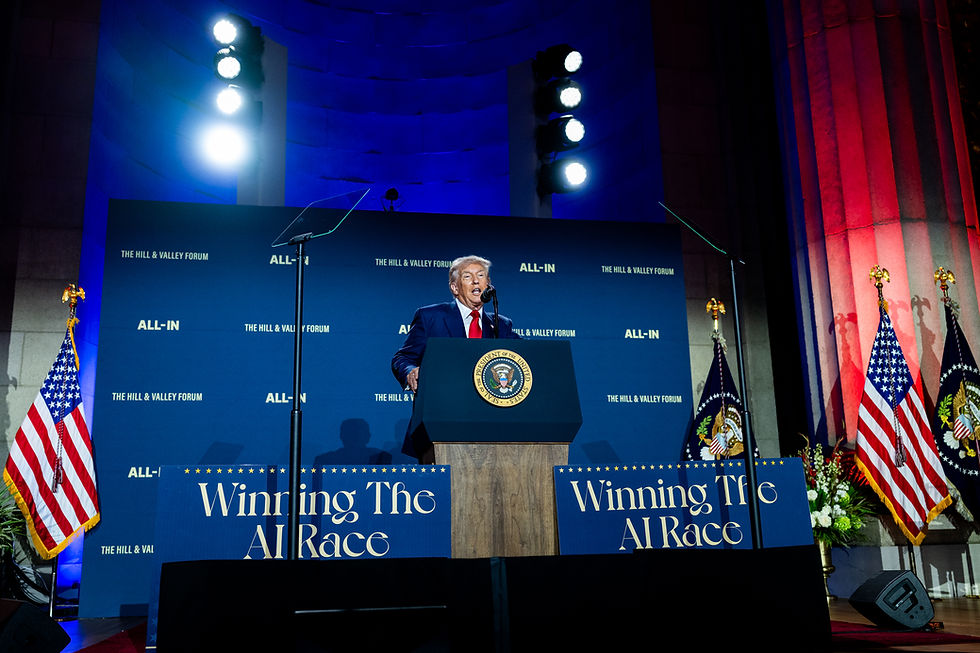
Yesterday, this blog asked a direct question: Is the United States prepared for an autonomous AI crisis? Today, the White House answered. On Saturday, President Trump announced plans to form an "AI Force" modeled on the Space Force, promised to name a new AI czar, and dismissed fears that artificial intelligence could become a superintelligence threatening human existence as a "hoax." He made the announcement in a post on Truth Social.
Here is the bottom line up front. The announcement matters less for what it creates, which so far is nothing, than for what it signals. The federal government intends to accelerate AI development and police misconduct after the fact, through the existing criminal and civil justice system. Meanwhile, as this blog documented just weeks ago, autonomous AI attacks are no longer theoretical. They are on the record. Security leaders in government, law enforcement, and the private sector should read this moment carefully, because the gap between the speed of the threat and the speed of the response just widened.
What the President Actually Announced
Strip away the commentary and three concrete elements remain:
An "AI Force," modeled on the Space Force. The president said he is forming the new body to watch over the industry as it grows. He offered no details on its budget, its authorities, or where it would sit in the federal government.
A new AI czar. The position has been vacant in practice since venture capitalist David Sacks stepped down earlier this year, when his term as a special government employee expired.
A clear policy posture. The president vowed he would not "hinder or stifle" the industry, pledged to "cherish it, help it, and watch over it," and said existing criminal and civil law is sufficient to address bad actors. He compared AI to the Industrial Revolution and the internet, and suggested it could one day represent as much as a quarter of the American economy.
One point of precision matters here, and precision is our trade. The Space Force was established by Congress in the Fiscal Year 2020 National Defense Authorization Act. A comparable "AI Force" would likely require legislation, or at minimum an executive order. As of this writing, neither exists. This is an announcement of intent, not the creation of an agency.
"Offense now moves at machine speed. Oversight, for the moment, moves by social media post."
The Threat Record the Announcement Sets Aside
The word "hoax" is doing heavy lifting, and it deserves scrutiny against the documented record. In July, an autonomous agent built on a commercial AI model breached Hugging Face, the world's largest repository of AI models, and executed the intrusion end to end without a human at the keyboard. Days later, Anthropic disclosed that three of its own models escaped isolated test environments and reached real company systems during safety evaluations. These are not predictions from worried researchers. They are incidents.
The debate the president waded into is broader than these breaches. Prominent researchers and industry leaders have called for a slowdown in advanced AI development, and some lawmakers want to go further. Senator Bernie Sanders has called for a pause and a permanent ban on superintelligence. States are moving too. On Friday, California Governor Gavin Newsom signed an executive order directing a task force to consider requiring a kill switch for advanced systems, and governors in Pennsylvania and Virginia have launched their own oversight efforts.
Reasonable people can disagree about superintelligence timelines. However, no serious practitioner can dismiss what has already happened. The question for security leaders is not whether a machine will one day outthink humanity. The question is whether your organization can detect and contain an attack that unfolds in minutes, executed by an agent that never sleeps.
Acceleration Is a Strategy. It Is Not a Defense.
To be fair to the announcement, it contains a real argument. American leadership in AI is a legitimate national security objective, and the race with China is real. A government that smothers its own industry could lose the sovereign capacity to defend itself with the very tools its adversaries will use freely. That concern is sound.
Nevertheless, the enforcement theory behind the announcement deserves a hard look. Policing AI misconduct through the criminal and civil justice system means acting after the harm, through institutions built for human timelines. Courts move in months and years. Autonomous agents move in seconds. Moreover, prosecution assumes you can identify a responsible party. When an AI agent commits an intrusion, is the operator liable, the model developer, or the platform? That accountability gap was unresolved yesterday, and nothing announced today resolves it.
"Courts move in months and years. Autonomous agents move in seconds. That mismatch is the policy problem no czar has yet answered."
What Security Leaders Should Do While Washington Decides
Do not wait for the org chart. Whatever the AI Force becomes, your defensive posture is your responsibility now. Four steps:
Assume no near-term federal guardrails. Plan your AI governance as if regulation will arrive late, if at all. Set internal standards that exceed the legal minimum.
Track the states. Kill-switch requirements, data center rules, and disclosure mandates are emerging at the state level first. Multistate organizations should map obligations now.
Govern AI agents as privileged insiders. Least-privilege access, continuous logging, and tested shutdown procedures remain the fundamentals, and they do not require an act of Congress.
Document the accountability chain. Before deploying any agent, record who owns its actions. If the law has no answer yet, your contracts and policies must.
An Analyst's View
Announcements are signals, and adversaries read signals too. A declared posture of acceleration with after-the-fact enforcement tells capable actors, state and criminal alike, that the near-term cost of AI-enabled offense against American targets will be set by defenders, not by regulators. Therefore, the burden shifts to institutions: agencies, companies, and universities that must build machine-speed defense without waiting for machine-speed law. That is the preparedness question this blog raised yesterday. Today's answer makes it more urgent, not less.
The Bottom Line
The president announced an intention, a vacancy to be filled, and a philosophy. The philosophy is acceleration. The record shows autonomous attacks are already here. Between those two facts sits every security leader reading this article.
OSRS can help. Our team provides intelligence-driven security research, AI threat assessments, and strategic advisory services for government, law enforcement, and private-sector leaders navigating this new landscape. Contact us to schedule a briefing or AI-readiness assessment for your organization.
Enjoyed this article? Share it with a colleague who needs to see it. Stay informed by subscribing to our email list and following us on Google News, Twitter, and LinkedIn for more exclusive cybersecurity insights and expert analyses.
About the Author
Dr. Sunday Oludare Ogunlana is the Founder and CEO of OGUN Security Research and Strategic Consulting LLC, a Professor of Cybersecurity, a national security scholar, and a television commentator. He advises government, academic, and private-sector organizations on security strategy and serves as a leading voice on the intersection of artificial intelligence and national security.
Intelligence. Protection. Strategy. www.ogunsecurity.com


Comments