
When the App Disappears: Microsoft's Project Solara and the Security Question No One Is Asking

Microsoft has placed a serious bet on the post-app era. Security leaders should study it now, not later.
On June 2, 2026, at its Build conference, the company unveiled Project Solara. The platform powers devices that run artificial intelligence agents in place of traditional applications. It is built on an enterprise version of Android, not Windows. Two reference devices already exist. A roster of major brands, including CVS Health, Best Buy, Target, Levi's, and AccuWeather, will begin pilots in the coming months.
The ambition is historic. Microsoft is attempting to repeat what it achieved with the personal computer. Then, it supplied the software layer that other companies built hardware around. Now, it wants to own the platform for a new generation of agent-first machines.
The technical choices reveal the strategy. The operating system is the Microsoft Device Ecosystem Platform, an Android fork the company already used for Teams room hardware. Microsoft selected it over Windows to reach smaller, lower-power devices. The company kept the controls that enterprises demand: over-the-air updates, device integrity, Microsoft Defender, Intune, and Entra ID sign-in. The devices themselves are thin. The intelligence lives in Microsoft's Azure cloud.
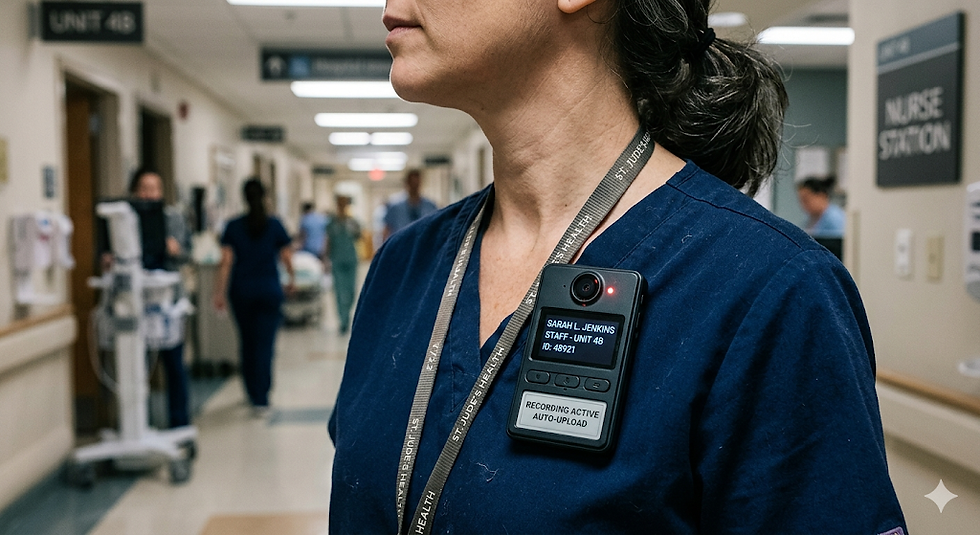
The first two designs sketch the vision. One is a desk hub that signs users in by face and pairs with a Windows PC. The other is a wearable badge that reimagines the employee ID card. A fingerprint press wakes an agent. A single tap records and transcribes a conversation. A built-in camera lets the agent act on what the wearer sees.
Here is where my attention sharpens.
The badge is a sensor that lives on a person's chest. It listens. It watches. It transcribes. In a hospital, it may capture a patient encounter. In a store, it may record a customer. The convenience is obvious. The governance burden is enormous.
Agent-first devices collapse the boundary between the user and the data. A traditional app asks you to open it and act. An agent acts for you, often across systems, sometimes without a visible interface. Microsoft calls this "just-in-time UI," where the screen assembles itself around the task. That fluidity is powerful. It also makes oversight harder. When the interface is generated on the fly, what exactly did the user consent to, and what record proves it?
Therefore, three questions should guide any leader weighing a pilot.
First, identity and access. Who authorized the agent, and what can it reach? Microsoft's Execution Containers aim to fence agents in. Test those fences before you trust them.
Second, data residency and recording. Where does the transcript go, who can compel its release, and how long does it live? In regulated sectors, this is not a feature decision. It is a compliance decision.
Third, sovereignty. The intelligence runs on Microsoft's cloud. For a government, a hospital network, or a financial institution, dependence on a single foreign platform is a strategic exposure, not a convenience.
Project Solara is early. Microsoft admits as much. The business model is unsettled, and the demos are illustrations, not finished products. However, the direction is clear, and the competition is fierce. Google,
Amazon and OpenAI are chasing the same prize.
In my opinion, the platform that wins will not be the one with the cleverest agent. It will be the one that proves it can be governed. Security and trust are no longer the fine print of computing. They are the product.
Dr. Sunday Oludare Ogunlana is the Founder and CEO of OGUN Security Research and Strategic Consulting LLC (OSRS), a Texas-based intelligence and cybersecurity firm. A Professor of Cybersecurity and a national security scholar, he advises global intelligence and policy bodies on the governance of artificial intelligence and emerging technology. He writes on the security implications of the agentic era at www.ogunsecurity.com.


Comments